
At their largest and costliest, video video games all form of look the identical. The rationale typically comes right down to easy economics: Extra assets means extra prices that have to be recouped, and traditionally the way in which publishers have carried out that’s by being comically risk-averse. Therefore the glut of semi-realistic rocky wastelands that appear to be dying steel album covers the place everybody is a few form of Wild West fetishist, or the hero shooters that each one appear to be Pixar however shredded as hell and prepared for fan artists to go locations I shall not.
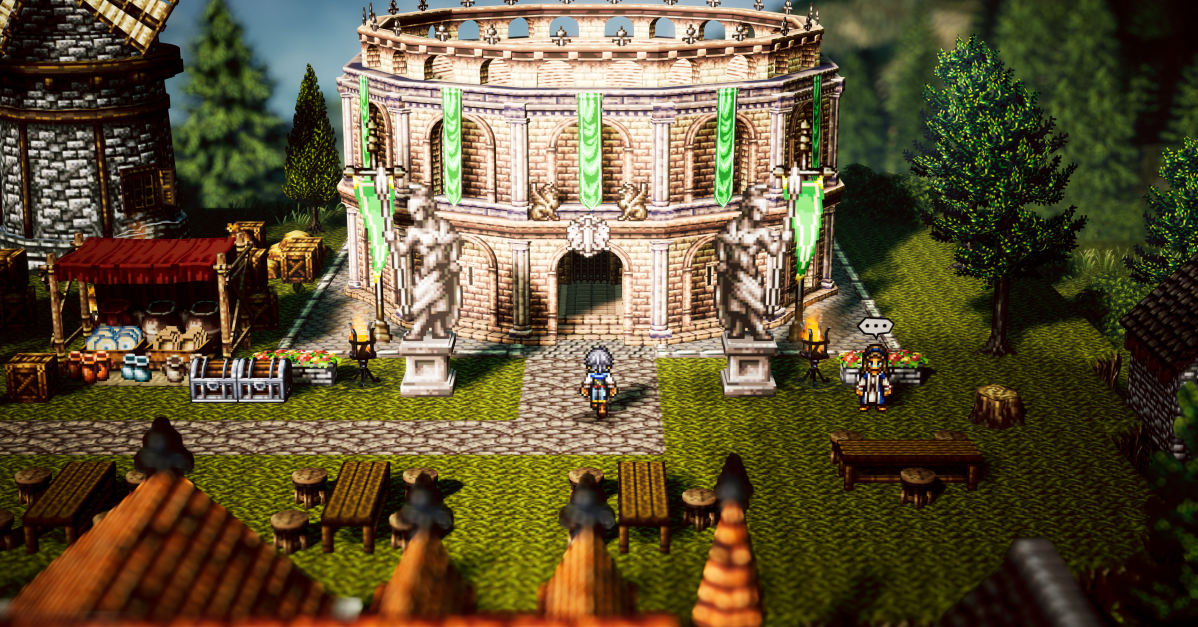
Every now and then, nevertheless, new visible floor is staked. Octopath Traveler 0 is an instance of this. The third sport within the Octopath collection is lots of issues — a newcomer-friendly prequel, a reconfigured adaptation of a cellular sport, a reasonably nice JRPG — but it surely’s additionally the tip of a 2025 victory lap for the artwork type that writer Sq. Enix has dubbed “HD-2D.” It’s a daring experiment that’s now a fixture of the discharge calendar — and in addition extremely uncommon in how a lot it communicates. An HD-2D sport from Sq. Enix is a press release about what outdated video games it considers classics price revisiting, and what new video games must be obtained as such.
“The HD-2D type started with the thought: ‘What if we revived video games from the Tremendous Famicom, the golden period of pixel artwork, utilizing trendy know-how?’” Masaaki Hayasaka, producer of this yr’s Dragon Quest I & II HD-2D Remake, informed The Verge through e mail. First utilized in 2018’s Octopath Traveler, the artwork type is supposed to evoke the pixelated texture and really feel that characterised 16-bit role-playing video games like Closing Fantasy VI, however with the depth and element afforded by trendy 3D graphics. The builders at Sq. and Octopath co-developer Purchase cleverly achieved this utilizing Unreal Engine, which allowed them to render — and, crucially, mild — Octopath like all trendy sport, inserting 2D characters that regarded ripped from a CRT display in a world designed to look nice on a contemporary display. The hope was that, as a brand new role-playing franchise debuting on the then-new Nintendo Swap, Octopath Traveler would instantly be seen as each completely trendy in its design, but in addition basic in a method that courted nostalgia-prone avid gamers.
It labored. After the gross sales success of Octopath Traveler, Sq. Enix trademarked the “HD-2D” name (however not the type), a sign of dedication to its new aesthetic paradigm. Then a humorous factor occurred: The subsequent two HD-2D video games from Sq. weren’t Octopath sequels, however the ways RPG Triangle Technique and a remake of 1994’s Stay a Stay, probably the most extremely acclaimed Tremendous Famicom RPGs to by no means get an official English-language launch. Each launched in 2022, these video games are the place HD-2D stops turning into a novel quirk and extra of a design ethos for the writer. An HD-2D sport both seeks to be the last word pastiche through authentic titles like Octopath, distilling an period’s price of hits right into a crisp new bundle, or it’s a loving re-creation of a sport that deserves a brand new day within the solar.
“There lies a chance to create room for the creativeness, which is exclusive to the pixel artwork type”
The sample holds: Octopath and its sequels proceed to be the one authentic HD-2D titles within the SNES-era JRPG type, with Triangle Technique holding down the ways sport finish and subsequent yr’s The Adventures of Elliot: The Millennium Tales searching for to do the identical for Zelda-style motion RPGs. On the remake entrance, Sq. Enix has launched Dragon Quest I & II HD-2D Remake with nice ceremony, following final yr’s tackle Dragon Quest III. (The backward launch order displays the order Sq. prefers gamers play them in.)
In each contexts, HD-2D has largely been a success with critics — or at the least, critics predisposed to taking part in the video games all of them lovingly homage. “It’s a stunning type that goes past a pure retro look to create one thing timeless,” writes Polygon’s Oli Welsh in reward of Stay a Stay’s use of the type, “an extension of a basic ’90s online game aesthetic into the current, which deepens and enriches it while staying trustworthy to its authentic character.” Many reviews of Octopath Traveler or its sequel name the video games “stunning” or “attractive.” Sq. Enix’s acknowledged aim of pioneering a visible language that does the tough work of being nostalgic and trendy on the similar time appears to be a convincing success.
“Maybe some gamers could view video games with pixel artwork as one thing outdated,” stated Octopath Traveler 0 producer Hirohito Suzuki, who additionally spoke to The Verge through e mail. “However there lies a chance to create room for the creativeness, which is exclusive to the pixel artwork type — and there aren’t any limits to 1’s creativeness.”
After all, there’s a enjoyable little cheat right here, one which the Octopath builders famous when describing the event course of for a 2019 Unreal Engine promo video. It’s that the HD-2D look owes simply as a lot to PlayStation-era titles like Xenogears and Grandia because it does the Tremendous Nintendo video games, making the type a a lot wider synthesis (and maybe much less novel) than it’s regularly billed as. That’s, nevertheless, no purpose to promote it brief — Sq. continues to reveal stunning selection with its HD-2D titles. Based on Hayasaka, understanding how a lot leeway the HD-2D method affords is essential to its profitable implementation.
“The definition of HD-2D is definitely quite simple, and for those who create characters and monsters as pixel artwork and place them on prime of a 3D background, that alone technically works,” Hayasaka stated. “After all, this alone wouldn’t seize the HD-2D-like high quality, so from there, you’d type every part from the colour palette, results, and digital camera to firmly create that ‘ambiance that feels proper.’ That’s extremely necessary and is the crux of HD-2D video games. So, I imagine the key to success for any HD-2D mission lies in having an artwork director who may grasp that feeling and sensibility.”
“Not one of the 5 titles launched to this point look precisely the identical”
The unique HD-2D efforts like Octopath and Triangle Technique are mockingly the least visually expansive, hewing to related muted coloration palettes and papercraft diorama-like staging. Colours make or break these video games, as overreliance on anyone vary of shades will threaten to flatten the planes and jeopardize the phantasm of depth. These shortcomings are made up for by astounding visible crescendos the place mild illuminates a scene in a method that feels frankly not possible. The remakes are extra colourful. The Dragon Quest video games are downright maximalist in a method that hardly bothers to evoke pixelated landscapes, leaning extra on the “HD” aspect of “HD-2D” and the power of Akira Toriyama’s distinctive character and monster designs. They create an opulent backdrop for the simplicity of a grasp cartoonist’s work, and the result’s equally, if no more, affecting.
“Even below the umbrella of HD-2D, not one of the 5 titles launched to this point look precisely the identical,” Hayasaka stated. “There are numerous methods to broaden the modifications made between them, from the colour palette to how a lot of the pixels’ grainy texture you carry out. That’s why I imagine it’s an expression technique that also has loads of room to develop.”
“Timeless” is one other phrase that’s used quite a bit in relation to HD-2D, in a method that speaks to its success and thoroughly thought of deployment. The aesthetic is one born from insecurity — the builders at Purchase initially wanted to make a classic 2D pixel-art game, however had been anxious that it wouldn’t be seen as sufficiently trendy. That battle is likely one of the core tensions of video video games, the push and pull between creative expression and technological progress. Artwork is a second captured in time, of the time it’s made even when poised to transcend it.
Video games, nevertheless, are additionally tied to their technological second, and know-how may be embarrassing. Pixel artwork smudged to hell by 4K screens, dialogue rendered indirect or infantile due to reminiscence limitations, music made for restricted sound chips awkwardly filling 5.1 encompass sound audio system. Greater than most different artwork types, the makers of video games should determine: Ought to limitations be preserved, or forgotten? Are compromises made for tech’s sake enduring creative decisions, or short-term acts of pragmatism?
The attractive delusion of HD-2D is in pondering that there may be a approach to craft an ideal model of a sport that may survive the ravages of time. A method of rendering a sport that’s reverent to the previous however not embarrassing to the long run. Flattering to the historical past of video games but in addition our trendy sensibilities, which prize comfort and ample “quality-of-life” options. There may be, nevertheless, no escaping these questions. We’ll age and alter, as will know-how and our relation to it. It’s stunning to attempt to transcend this, and it’s stunning to fail, as most of us will. Video video games all look the identical, till they don’t.