
Taylor Swift has been at the center of AI imitation controversies for years, and now, she’s turn into the most recent movie star who’s escalating makes an attempt to guard herself from AI copycats. As typical, nonetheless, the authorized system intersects with expertise in sophisticated methods — and Swift’s efforts could also be an extended shot.
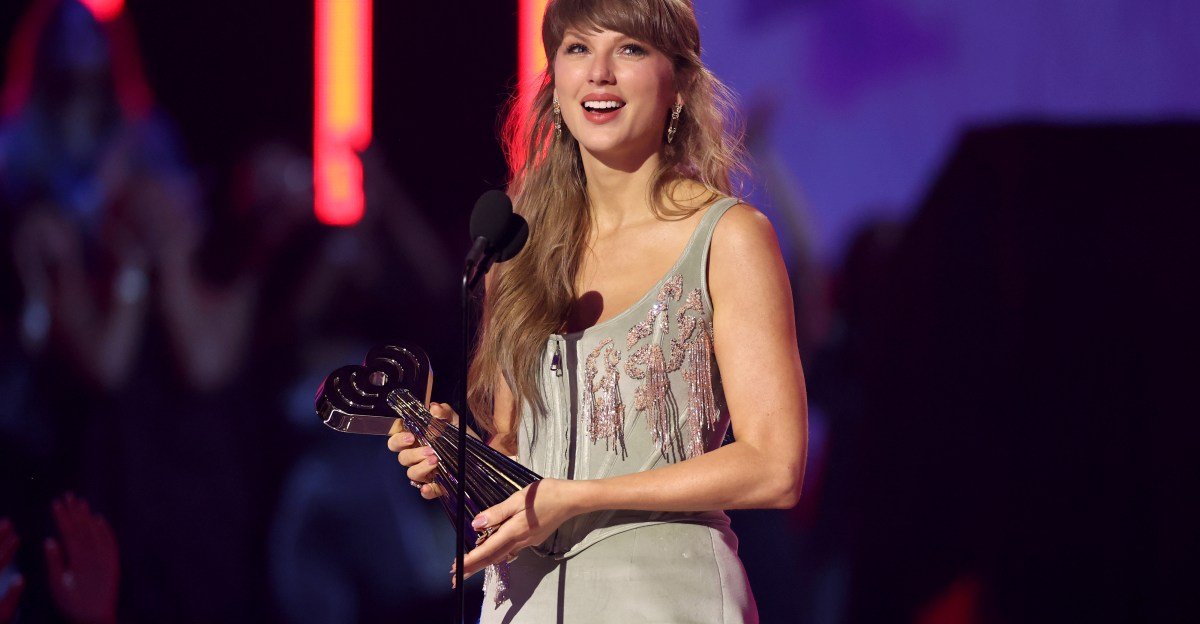
In trademark purposes filed final week, Swift’s staff requested for cover for 2 phrases spoken by the singer: Hey, it’s Taylor Swift and Hey, it’s Taylor. The trademark purposes, filed by TAS Rights Administration on behalf of Swift, embody audio clips of Swift saying the 2 phrases as a part of a promotion for her newest album. “Hey, it’s Taylor Swift, and you may hearken to my new album The Lifetime of a Showgirl on demand on Amazon Music Limitless,” Swift says in one of many clips. TAS Rights Administration filed a trademark application for a photograph of Swift as nicely, which exhibits the musician “holding a pink guitar, with a black strap and sporting a multi-colored iridescent bodysuit with silver boots” on stage.
Although Swift’s staff hasn’t stated that the emblems are supposed to defend towards AI misuse, it looks as if a probable chance given Swift’s historical past with AI. Not solely has the star needed to take care of the specter of AI music, however Swift additionally contended with an onslaught of sexualized AI deepfakes.
Artists have lengthy used copyright regulation to guard their music, however the rise of AI-generated tracks has made defending their work and likenesses more difficult. That’s as a result of copyrights only protect an artist’s song — not their voice. Authorized groups have needed to get a bit artistic in consequence, with Common Music Group (UMG) issuing copyright takedown requests of an AI-generated Drake music, citing the Metro Boomin producer tag that performs firstly.
As defined by IP attorney Josh Gerben, emblems may assist fill the hole created by AI-generated mimicry. As an alternative of concentrating on actual copies of her music, Swift “may doubtlessly problem not solely equivalent reproductions, but additionally imitations which can be ‘confusingly comparable,’” in line with Gerben. The picture of Swift, equally, might be doubtlessly used to take motion towards comparable AI-generated imagery. Earlier this 12 months, Matthew McConaughey similarly obtained emblems for video clips of himself, together with one the place he says “Alright, alright, alright” to guard towards AI misuse.
However Alexandra Roberts, a professor of regulation and media at Northeastern College, tells The Verge that she’s “skeptical” that the audio clip submitted by Swift’s staff “demonstrates use as a mark, reasonably than only a phrase that’s included as a part of an extended message”:
Usually for a soundmark we’d consider one thing just like the NBC chimes or the MGM lion roar that performs firstly of every present or film in isolation… If the USPTO [US Patent and Trademark Office] does problem preliminary refusals, Taylor’s staff can have an opportunity to supply completely different specimens which may do a greater job satisfying the use requirement.
Swift’s emblems may function one other authorized instrument in her arsenal towards AI-generated copycats, even when they’re legally murky. Xiyin Tang, a regulation professor on the College of California, Los Angeles, tells The Verge that emblems may assist “warn off unsophisticated infringers by directing them to a federal registration quantity and certificates of registration and hope that convinces them to cease, not as a result of the federal registration would truly maintain up in courtroom.”
There are already some avenues Swift’s staff may take, together with the right of publicity laws enacted throughout a number of states, which permit individuals to take authorized motion towards the misuse of their identify or likeness. Artists can fight false promoting and endorsements by way of federal regulation, too. “Swift additionally has quite a few trademark registrations for her identify, so she will sue for federal trademark infringement if there’s a use of her identify by another person that creates a probability of confusion,” Roberts says.
To this point, solely Tennessee has handed a regulation that particularly addresses AI-generated copycats of an artist’s voice. Even YouTube’s deepfake detection tool, which provides celebrities, politicians, journalists, and creators the power to take down AI-generated lookalikes, solely applies to individuals copying their faces for now. Within the absence of a bigger framework for AI soundalikes, artists like Swift could hope trademark regulation will assist defend towards AI mimics which can be coming not only for their faces, however their voices, too.