
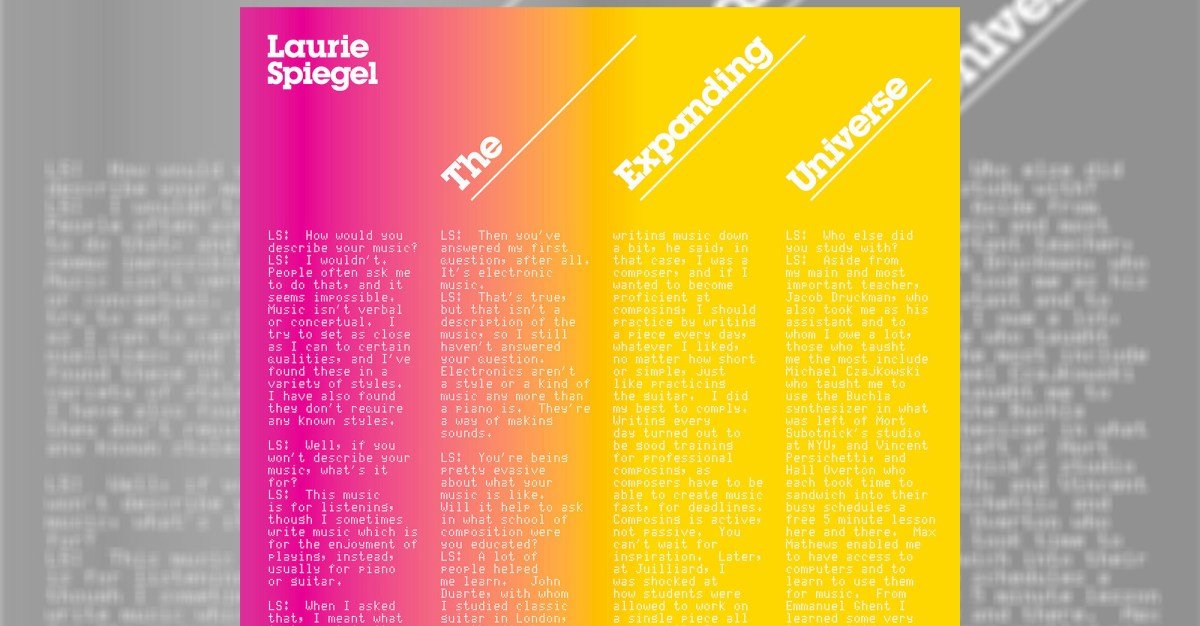
I lately had the pleasure of interviewing Laurie Spiegel for the positioning. As preparation for the interview, I spent a number of time during the last couple of weeks revisiting Spiegel’s information, most notably The Expanding Universe, her 1980 masterpiece that blends synth experimentalism with early examples of what would ultimately be known as ambient music, and algorithmic composition strategies. It’s a marvel that sounds each nostalgic and cutting-edge on the identical time.
Tracks like “Patchwork” and “A Folks Research” dabble within the type of bouncy arpeggios that beg comparisons to The Who’s “Baba O’Riley,” whereas “Outdated Wave” and “East River Daybreak” conjure early M83 or Boards of Canada. The palette she attracts from is buzzing with life and timeless, hardly ever relationship itself in the best way her later (additionally wonderful) document Unseen Worlds does, because it sometimes dabbles in FM bells.
There are additionally slower forays into extra typical ambient appears like “Appalachian Grove II” or “The Unanswered Query,” whose melodies transfer at such a glacial tempo that they will really feel virtually fully random at occasions. Tracks like these and “Music for Dance II” wouldn’t really feel misplaced on fashionable ambient Instagram or modular synth YouTube, scenes that clearly owe loads to Spiegel’s pioneering works.
Whereas the overwhelming majority of the tracks fully lack percussion, there are just a few exceptions, most clearly the fast-paced and polyrhythmic “Drums.” However the standout to me is “Clockworks,” which ventures into the type of proto-industrial grime and rattle you’d discover on a Throbbing Gristle document or perhaps a fashionable Trent Reznor rating. The truth that it doesn’t seem to have been sampled (not less than in accordance with WhoSampled) and repurposed because the spine of an underground hip-hop monitor is stunning to me.
Whereas The Increasing Universe doesn’t essentially current a cohesive imaginative and prescient, it nonetheless feels just like the singular expression of an artist on the peak of their recreation. The 2012 reissue provides to Spiegel’s legacy by together with over 100 minutes of further materials not on the unique launch.
Whereas the concept of 70s experimental synth music may scare off informal listeners, there’s something inviting about a number of the works on The Increasing Universe. Positive, some tracks, just like the one-two punch of closers “Kepler’s Concord of the Worlds” and “Wandering in Our Instances,” aren’t afraid to take a seat for prolonged durations in dissonance and confrontational tones, however for essentially the most half, Spiegel’s compositions are tuneful and approachable.