
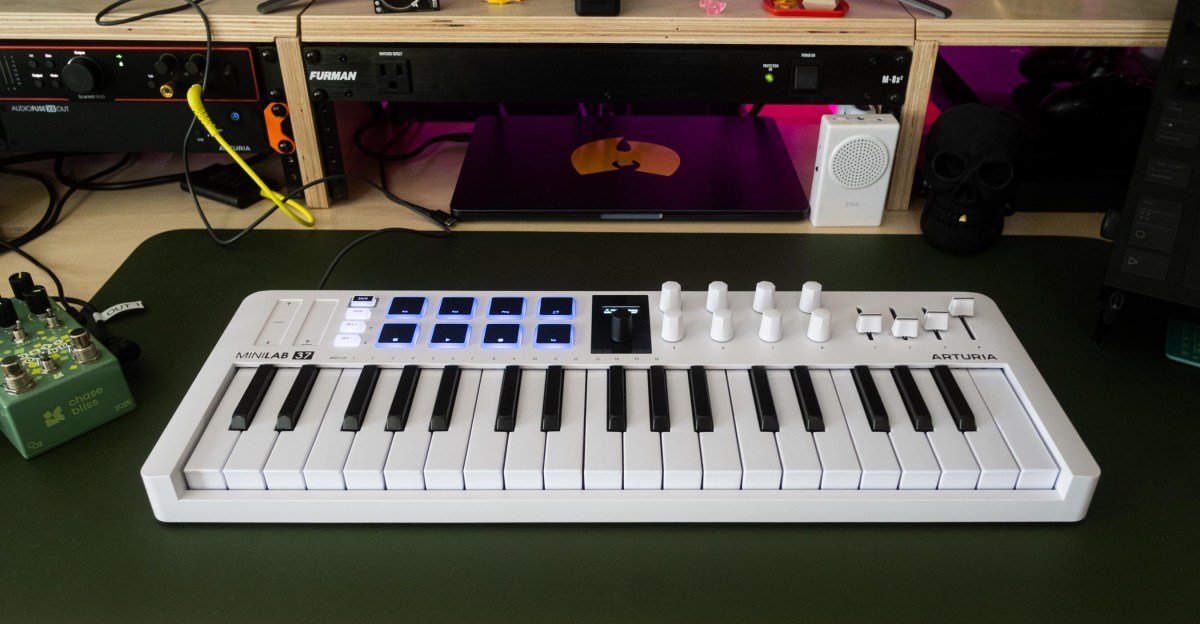
I’ve examined extra portable MIDI controllers than I can maintain monitor of, and I’ll inform you proper now: 37 keys is the best measurement. Whereas Arturia’s 25-key MiniLab MK3 is a strong controller that simply suits in a backpack, it feels a bit claustrophobic. The brand new $149 MiniLab 37 provides one other octave, supplying you with way more room to play bass and lead concurrently, or simply play extra expansive chords.
Bodily, the MiniLab 37 isn’t very completely different from its smaller sibling. It’s acquired the identical strong (if barely springy) keybed, eight pads, eight countless encoders, 4 faders, a pair of contact strips, USB-C, and a full-size five-pin MIDI DIN out on the again. It’s additionally acquired the identical rounded plastic construct. It feels a bit low-cost, and it’s not gonna win any design awards, nevertheless it will get the job accomplished and feels resilient sufficient to take just a few bumps in a backpack.
The large change is that it’s simply not as cramped as the usual MiniLab, and it’s not nearly having extra keys. With a wider expanse to work with, Arturia was in a position to rearrange the opposite controls for simpler entry; the entire controller is shallower. You not have to succeed in over the pads to get to the knobs, or the touchstrips to alter the octave. As a substitute, every thing is specified by a straight line, with the first encoder and small LCD proper within the heart. It’s simply a way more pleasurable and intuitive expertise. With the MiniLab MK3, I all the time felt like I used to be looking earlier than reaching. On the 37, issues are simply the place I’d count on them to be.
Integration with Arturia’s software synths is a part of the enchantment of its controllers. The MiniLab 37 comes bundled with Arturia’s Analog Lab Intro and Ableton Reside Lite so you will get straight to creating music out of the field. However maintain your expectations in test. That tiny display means you continue to want to succeed in for the mouse or keyboard to flick thru presets effectively. And it additionally makes utilizing a number of the controller’s extra superior contains a bit cumbersome. For instance, the built-in arpeggiator is nice, with a ton of choices contemplating this can be a moveable, budget-minded MIDI controller. However the price, the mode, the gate, and so on., require scrolling and clicking by means of them one after the other. It’s a slog.
The MiniLab additionally provides you primary management over your digital audio workstation (DAW), permitting you to begin or cease recording or loop particular elements of your session straight from the controller. When you’re affected person, you possibly can manually map it for even deeper management of your recording session, nevertheless it’s by no means going to match one thing like Ableton’s Push and even Serato’s Slab, which have way more hands-on controls and out-of-the-box mappings for his or her respective DAWs.
It’s also possible to management {hardware} synths utilizing the MIDI port on the again. You would even construct an entire DAW-less setup with a number of devices on completely different MIDI channels. Although in case your devices don’t have MIDI out or via ports, you’ll want so as to add a MIDI splitter to your setup.