
It’s typically frowned upon to care an excessive amount of about appearances. We have now a variety of little aphorisms discouraging this — books and their covers, magnificence being pores and skin deep, type over substance, that type of factor. Self-importance is a threat. Ought to one put a disproportionate effort into how a factor seems, then mentioned work could very nicely be thought of shallow. However on this planet of big-budget video video games? That’s the way you win.
Visible constancy is online game shorthand for progress: how meticulously rendered a mountain is, how dynamically the snow behaves, how a participant character raises their fingers to the touch a wall when the participant approaches it simply so. This pursuit can change into absurd, as illustrated by Rockstar Video games’ compulsion to animate horse testicles responding to ambient temperature in 2018’s Pink Lifeless Redemption 2. It additionally has little or no to do with something a participant, nicely, does. That is the place Housemarque diverges from its friends.
The Finnish developer is an oddball within the PlayStation Studios roster. Acquired by Sony in 2021, the store was identified for arcade video games like Tremendous Stardust HD and Resogun, twin-stick shooters and shoot-’em-ups that leverage up to date {hardware} to make their bullet hells seem extra like bullet heavens, filled with fireworks and lasers vibrantly rendered however within the service of video games within the custom of Asteroids or Defender. They’d be good in the event that they didn’t look as sharp, nevertheless it’s cool that they did.
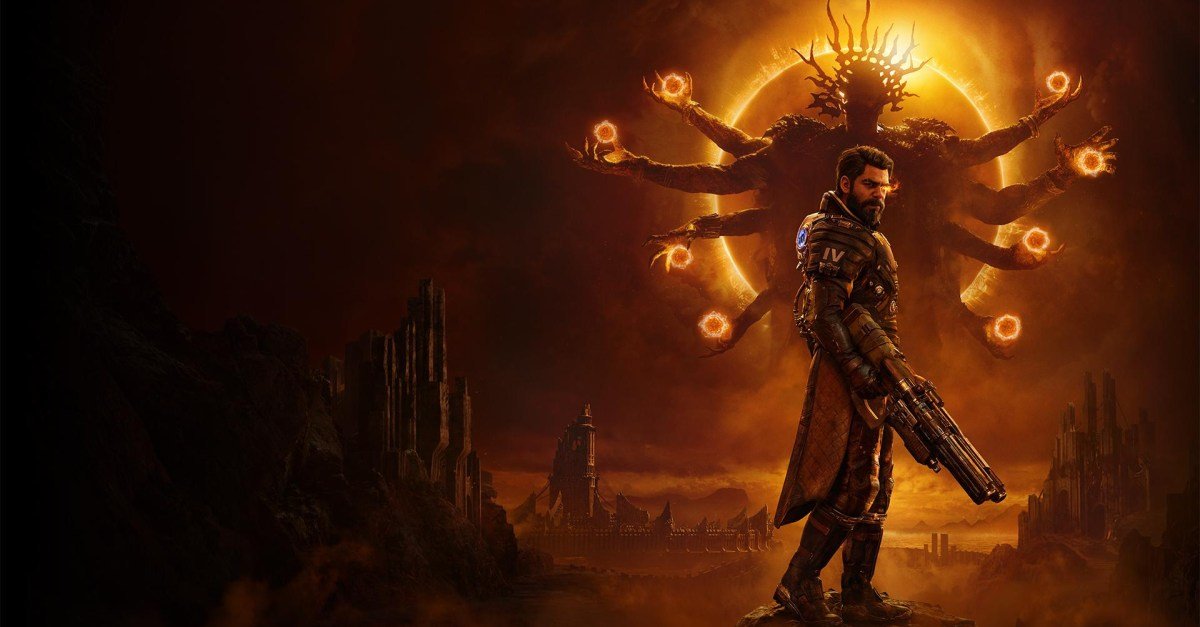
Saros, the studio’s latest game, operates on an analogous precept. Like Returnal, Housemarque’s 2021 PlayStation Studios debut, it’s one other basic arcade-style sport reimagined from the angle of Sony labelmates like God of Conflict or Horizon. It has an eye fixed for dramatic style storytelling and lavish presentation however with out the obsessive pursuit of realism that may outline dialog round these video games.
“To me, realism shouldn’t be fascinating to pursue,” says Saros lead artist Simone Silvestri. “Saros is a stylized, practical sport, which makes certain that we will bend the world to the loopy gameplay that we have now. The extent of element that we would like could be very intentional, very managed, in order that we will make canvases for the gameplay. I feel that’s why we then get much more leeway to fall in love with the {hardware} as a lot as we do.”
In Saros, the participant assumes the function of Arjun Devraj (carried out by actor Rahul Kohli), a member of a group despatched to the planet Carcosa to research the disappearance of mining colonists despatched to reap a miracle mineral known as Lucenite. One thing occurred to them, and one thing is presently occurring to Arjun, and it’s on this disorienting state that Saros begins. If the participant needs to determine any of this out, first they must learn to play Housemarque’s dextrous, arcade-like method to motion video games.
It’s an method that’s just like Returnal, an alternate universe by which AAA video video games are much less thinking about cinematic verisimilitude and extra thinking about escalating gameplay, participating in an arms race for ludic athleticism. Throughout these two video games, Housemarque posits one other manner of being “next-gen” and pushing the benchmark ahead, one not predicated on the pursuit of photorealism however on utilizing the entire gameplay cow, so to talk.
“A variety of the time the cinematics are about setting issues up or providing you with inquiries to ask, and thru the sport expertise, you reply them.”
”The primary reference for our video games are our personal video games,” says Saros director and co-writer Gregory Louden. “We’re gonna have actually particular story moments for you, however they’re gonna be actually rewarding. You’re gonna personal them, so I’m not gonna give them away at no cost. We’re additionally gonna make our cinematics about questions. The gameplay is the reply. So a variety of the time the cinematics are about setting issues up or providing you with inquiries to ask, and thru the sport expertise, you reply them.”
In Returnal and Saros, computing energy isn’t simply used to craft detailed environments, however to fill the display with orbs of various colours, to make use of the instantaneous load occasions as a option to underline every sport’s dizzying cycle of loss of life and rebirth, to overwhelm the participant with impossibly swift creatures, and arm them with weapons that defy physics and provides distinctive haptic suggestions. Environments are filled with writhing flora that’s all the time in movement, generally ready to ensnare the participant, to embody a sense of psychological or cosmic horror. To replicate no matter inner hell the participant character — a middle-aged lady and an Indian man in Returnal and Saros, respectively, each woefully uncommon on this planet of online game protagonists — is trapped in.
That is additionally the Housemarque philosophy: Visible constancy really has little or no to do with the immersiveness that many video games doggedly pursue by way of graphical prowess. “Immersion doesn’t come from realism,” Silvestri says. “It comes from the believability of the sensations and the emotions that you’ve got within the second.”
This aligns with Louden’s purpose of kinetic storytelling that doesn’t begin with the melodrama of the standard online game cutscene. Housemarque’s PlayStation Studios-era video games intention to get you fascinated about the characters you embody via taking part in as them, however the lure of being a “gameplay-first” studio (as Housemarque describes itself) is that gamers could solely think about that gameplay, and never its narrative implications. Saros and Returnal every have a pair deft tips for confronting this, every asking the participant to make satan’s bargains as they work their manner via the live-die-repeat of a run. Returnal’s small-scale try concerned parasites, which might connect themselves to protagonist Selene and supply a perk that got here with a gameplay tradeoff. Saros does this with upgrades that undergo from “Corruption,” a mysterious affliction that infects the whole lot within the sport.
“What occurs when the long run isn’t what you need it to be?”
The participant doesn’t must assume too deeply about any of this, however the nudge is compelling, a Mobius strip of gameplay and character that provides the “bullet ballet” that Housemarque has choreographed a layer of psychological depth.
“We’re creating a personality that you would be able to look at and research,” says Louden. “And never only one: We have now many characters [in Saros] with many competing targets, all looking for their manner ahead. A lot of them are leaving one thing to come back to this hostile alien planet. They know that it’s hostile once they go there. They know they’re leaving their previous, however they’re all going there for a brand new future. What occurs when the long run isn’t what you need it to be?”
Saros’ confrontation with a hostile future that’s totally different from what’s anticipated is an apt metaphor for the studio. Housemarque stays atypical amongst AAA builders, and whereas Saros presents some concessions to a extra welcoming expertise than Returnal’s infamous problem, it’s nonetheless an odd duck amongst its sister studios and their emphasis on cinematic sprawl. Completely different is sweet, however within the high-stakes, costly realm of blockbuster video video games, it’s additionally dangerous.
These are video games that don’t simply must promote themselves, they should promote the console they’re on. That makes dangerous a legal responsibility. As a result of folks do, in reality, decide a e-book by its cowl.